
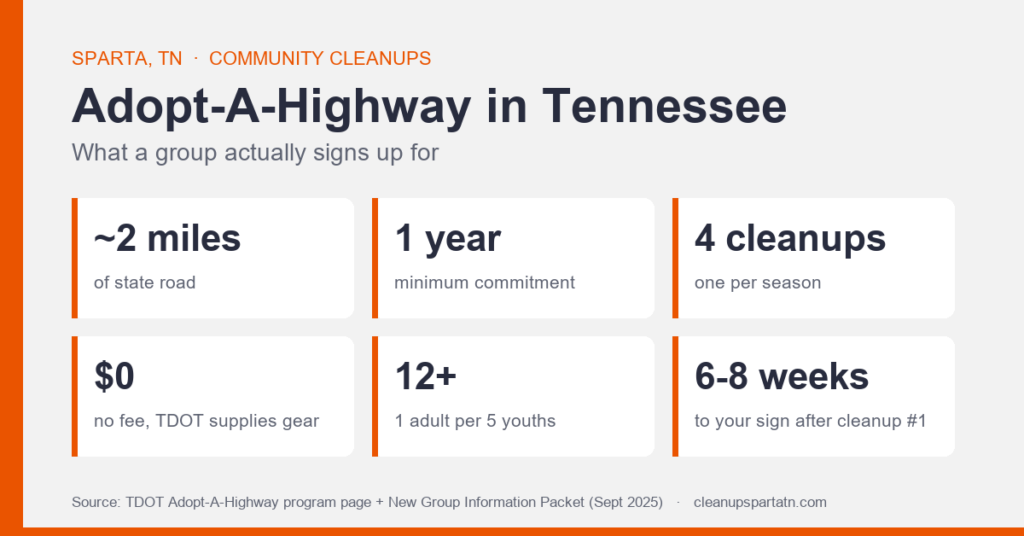
Tennessee’s Adopt-A-Highway program asks a group to take about two miles of state road for at least a year and clean it four times. There is no fee. TDOT hands you the vests, bags and warning signs, and its own crews haul the full bags away. After your first cleanup, your group’s name goes on a panel under the official sign.
That is the whole deal, per TDOT’s program page. It is also the cheapest way we know for a Sparta crew to turn a one-off Saturday into something that repeats.
The commitment is smaller than most people assume
Four cleanups a year is one per season, and that is exactly what TDOT recommends. The program FAQ says groups are asked to adopt “approximately two miles of roadway for at least one year and conduct a total of four litter clean ups,” and that groups can go out more often if they want to.
Here is what else the program page and TDOT’s New Group Information Packet set out:
- Who can join. Any group or individual over 12. Volunteers aged 12 to 17 need a parent’s permission, and TDOT requires one adult for every five youths under 18.
- What TDOT provides. Safety vests, trash bags, caution signs and the safety video.
- What happens to the bags. You call the district coordinator with your bag count, and TDOT Maintenance picks them up.
- The sign. Recognition signage goes up after your first pickup, and installation “normally takes between 6-8 weeks.”
- The records. After every cleanup you file an online volunteer activity report.
Statewide, TDOT says its volunteers have collected more than 12 million pounds of litter from Tennessee roadsides since the program started in 1989.
The paperwork comes before the first bag
Most of the effort sits before cleanup day, and it lands on whoever coordinates the group. The packet lists the steps:
- Submit the volunteer application, then contact your district coordinator, who assigns your two-mile stretch.
- The group coordinator signs the Partnership Agreement Form.
- Every volunteer watches the safety video and signs the liability release. Parents of 12 to 17 year olds watch the video with their kids and sign the consent section.
- Hold a safety briefing before your first pickup.
- Collect your materials from the district coordinator during business hours.
The line that catches groups out: every new volunteer has to go through the video and the form before they can join a cleanup. That is the right rule for people working beside traffic, and it changes how you recruit. A neighbour who turns up on the morning without the paperwork can’t just grab a vest.
So send the video link and the form the moment somebody says yes. We wrote about why that response window matters in if somebody offers to help, answer them. A highway crew makes the point sharper, because a slow reply now means a volunteer who misses a whole season.
TDOT publishes a county-by-county list of district coordinators, updated October 2025. White County has its own named contact on it. Start there.
Cleanup day has rules that surprise first-timers
A park cleanup and a roadside cleanup are different jobs. TDOT’s safety guide is specific, and a few of its rules are worth reading out loud at the briefing:
- Everyone wears a vest the whole time. The caution signs go at both ends of your stretch, facing oncoming traffic.
- Work in groups of six to ten, in pairs, facing traffic.
- Avoid peak travel times. Don’t work on holiday weekends. Stop in bad weather.
- Don’t pick up anything on bridges, in tunnels or on overpasses, and nothing from the pavement or the median.
- Stop filling a bag when it feels heavy, about 10 pounds, and don’t compact it.
- No headphones, and no phones or cameras while you are working along the road. Take the group photo before and after.
The packet also teaches a three-way sort it calls Bag It, Move It, or Leave It. Small items without sharp edges go in the bag. Large, heavy or awkward items that would tear a bag go next to your stacked bags at the edge of the shoulder. Anything sharp, unidentifiable, leaking, labelled hazardous, or within six feet of a traffic lane stays where it is. “If in doubt, leave it alone!”
One more warning from the packet is worth knowing in rural Tennessee: dumped meth lab waste can look like ordinary trash. Taped-shut bags, containers with tubing, bottles of separated liquid, corroded propane tanks. Don’t touch any of it. Call the TBI Meth Watch Hotline at 1-877-TNN-METH.
It fits a crew you already run
If you already have a small group doing cleanups around Sparta, the program slots into the structure we laid out in volunteer chapters beat one big event. Each of those five roles has a TDOT job attached:
- Coordinator: the TDOT contact, the partnership agreement, picking the four dates.
- Supplies: collecting the vests, bags and signs, and returning them within three days of each cleanup.
- Safety: the tailgate briefing, the sign placement, the adult-to-youth ratio.
- Photographer: the before and after group photos, taken off the roadside.
- Follow-up: the bag count call, the online report, and the thank-you with the next date.
The four-a-year rhythm helps with the problem that kills most volunteer groups, which is momentum after the first few outings. A date every season is easy to hold. The sign helps with recruiting, because people driving past see a local name on it every day.
The reports help us too. In sorting beats hauling in White County we said we would measure what a Sparta cleanup collects rather than guess. A bag count filed with TDOT after every pickup is exactly that kind of number.
What we don’t know yet
We have not checked which stretches in White County are already adopted. TDOT keeps an Adopt-A-Highway map, and the district coordinator assigns the actual road, so that is the first question to ask. The program also covers state roads only. Its liability release refers to work “on or near state-owned right-of-way,” so a city street or a county road is a question for the City of Sparta or White County, not TDOT.
Two miles, four Saturdays, no cost. If your group has done one cleanup and wondered how to make it the first of many, this is the form to fill in next.