If you run a small business in Tennessee, energy costs are probably one of your most frustrating line items. Prices creep up, margins stay tight, and “going green” sounds like something only big corporations with sustainability budgets can afford. That’s not true — and it’s getting less true every year.
Here’s a practical rundown of funding programs, incentives, and no-investment strategies Tennessee SMBs can use right now to reduce energy costs and move toward cleaner operations.
Start With What Costs You Nothing
Before any funding conversation, audit what you’re already wasting. Tennessee Valley Authority (TVA) — which powers most of Middle Tennessee including Cookeville and Sparta — offers free energy audits for small commercial customers through its local power distributors like Volunteer Energy Cooperative and Caney Fork Electric. An auditor walks your space, identifies inefficiencies, and hands you a prioritized list of fixes. Many business owners find they can cut 15–20% off their bill just from behavioral and operational changes with zero capital outlay.
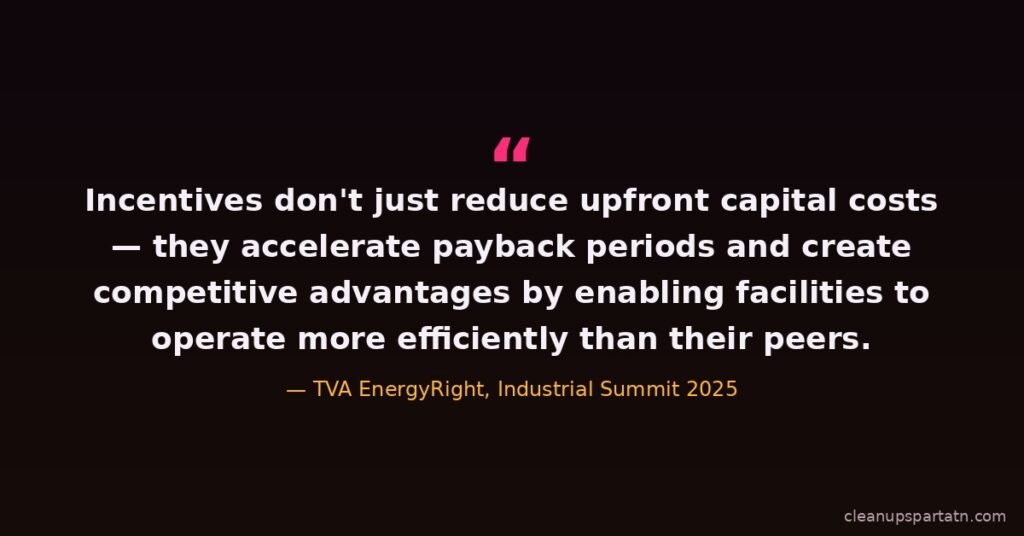
TVA EnergyRight® Programs for Small Business
TVA’s EnergyRight® for Business program is the most accessible starting point for Tennessee SMBs. Key options include:
Midstream equipment rebates — TVA pushes rebates directly through distributors for HVAC upgrades, lighting retrofits (LED), smart thermostats, and insulation improvements. You buy the efficient equipment, your contractor applies for the rebate, and you get cash back — sometimes covering 30–60% of the cost.
Small Business Energy Saver Program — For businesses under a certain energy threshold, TVA and local co-ops have historically offered direct installation of energy-saving measures at low or no cost. Availability varies by distributor, so call Caney Fork Electric or Volunteer Energy directly and ask specifically about small commercial programs.
Federal Tax Credits (These Are Real Money)
The Inflation Reduction Act extended and expanded federal tax credits that apply directly to small businesses:
Energy Efficient Commercial Buildings Deduction (Section 179D) — If you own your commercial building and make qualifying improvements to lighting, HVAC, or the building envelope, you can deduct up to $5.00 per square foot. Even partial improvements qualify for partial deductions.
Investment Tax Credit (ITC) — Installing solar? The federal ITC covers 30% of the installation cost as a direct tax credit. For a $20,000 system, that’s $6,000 off your tax bill, not just a deduction. Paired with TVA’s net metering policies, solar ROI in Tennessee is often under seven years for commercial installations.
Small Business Energy Efficient Appliance Credits — Check with your CPA about whether equipment upgrades at your location qualify under current IRA provisions. The rules shift by equipment type and installation date, so a quick conversation with a tax professional familiar with Section 48 credits is worth the hour.
USDA REAP Grants for Rural Tennessee Businesses
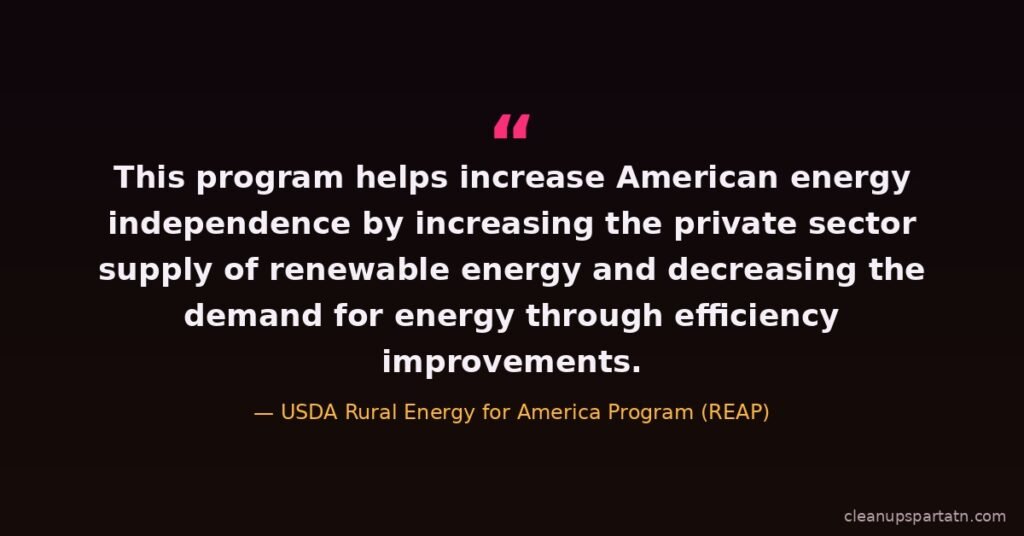
If your business is located outside a major metro — which describes most of White County (Sparta) and much of Putnam County outside Cookeville proper — you may qualify for the USDA Rural Energy for America Program (REAP).
REAP provides grants covering up to 50% of project costs for renewable energy systems (solar, geothermal, biomass) and energy efficiency improvements. The application process is more involved than a rebate, but for projects in the $10,000–$500,000 range, it’s one of the most generous funding sources available to rural small businesses anywhere in the country. The USDA Tennessee Rural Development office in Nashville handles applications and can walk you through eligibility.
Tennessee’s Green Energy Loan Programs
The Tennessee Department of Environment and Conservation (TDEC) has periodically administered low-interest loan programs for energy efficiency and clean energy projects through its Energy Division. These programs come and go with state budget cycles, so it’s worth a direct call to TDEC’s Energy Division to ask what’s currently active.
Additionally, the Small Business Administration’s (SBA) 504 Loan Program can be used for energy efficiency upgrades when the project results in a 10% or greater reduction in energy consumption. Interest rates are below market, terms run 10–25 years, and the down payment requirement is typically just 10%. For a small business that owns or is buying its building, this is a realistic path to financing solar or a complete HVAC overhaul.
Community Anchor: What Clean Up Sparta TN Is Building
Organizations like Clean Up Sparta TN are doing the connective tissue work — building awareness among local SMBs about green energy options, maintaining a directory of green companies in the Sparta and Cookeville area, and helping businesses understand that sustainability isn’t just an environmental stance. It’s a financial strategy. It’s a reliability question too: TVA expects data center load in the region to double by 2030, and that growth is part of why substations are getting walls.
The green companies directory they maintain is worth bookmarking if you’re looking for vetted local contractors who understand the rebate and incentive landscape and can help you structure a project that captures available funding rather than leaving it on the table.
The No-Investment Playbook (Do These First)
Download the Green Energy TN Playbook
Even if you’re not ready for a solar install or HVAC replacement, these moves cost nothing and compound over time:
- Request a free TVA/co-op energy audit — the list they give you is your roadmap
- Shift high-draw equipment to off-peak hours — many commercial rate structures have time-of-use pricing where off-peak electricity is significantly cheaper
- LED lighting swap — payback periods are typically 12–18 months even without rebates; with rebates, often under six months
- Smart thermostats and programmable controls — especially effective for retail and office spaces that sit empty nights and weekends
- Seal it up — weatherization (caulk, weatherstripping, door sweeps) is the least glamorous and most cost-effective thing on the list
Where to Start This Week
- Call your local co-op (Caney Fork Electric: 931-761-2168 / Volunteer Energy: 800-459-8881) and ask about small commercial energy programs and free audits.
- Visit energyright.com/business and review current rebate offerings.
- Talk to your CPA or tax preparer about the ITC and Section 179D before your next fiscal year ends.
- If you’re in a rural area, look up the USDA Tennessee Rural Development office and ask about REAP eligibility.
- Check the green business directory at Clean Up Sparta TN for local contractors who know this landscape.
Tennessee’s energy infrastructure, rural designation status, and federal program eligibility put most small businesses in the state in a surprisingly strong position to reduce costs and go greener — if they know where to look. Most don’t. That’s the gap worth closing.